

Most practice owners think their firm is worth roughly 1.2 times their annual fees. That number has been repeated at ICAEW events for decades. In 2026, it is still being quoted. And in 2026, it is almost useless on its own.
Here is the truth. Two firms in the same city, each with £300k of recurring fees, can sell for very different amounts. One might go for 0.8x. The other might achieve 1.5x or more. The gap is not luck. It comes down to fee quality, tech setup, client profile, and whether the firm runs without you.
This guide shows how accountancy practice valuations actually work right now in the UK. It covers the current market ranges and what you can do to push your number in the right direction.
The 1.2x Gross Recurring Fees rule was a fair shorthand when the market was simpler. Buyers wanted a steady fee income. Every firm looked much the same. So, they paid much the same price.
That has changed. The 2026 UK market is more complex. Buyers are picky. Private equity is more active. Making Tax Digital has changed what a good client base looks like.
Why the Old Number No Longer Works
The gap between a cloud-run, well-staffed firm and a paper-heavy sole trader has never been wider. Relying on a 30-year-old rule to price your life’s work is a real risk.
“In 2026, some firms are hitting 2.0x GRF or more. Others are struggling to reach 0.8x. The difference is not firm size. It is firm quality.”
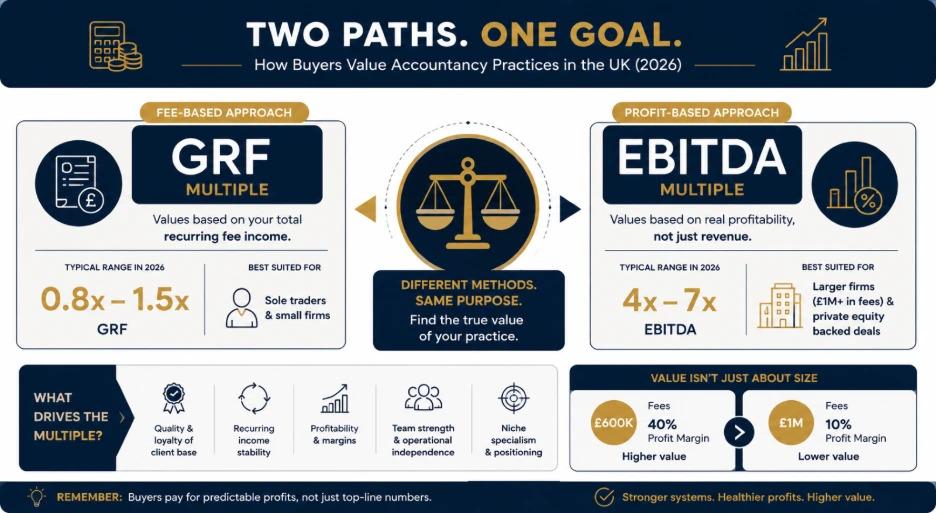
There are two main ways buyers value accountancy practices in the UK right now.
This is still the main method for sole traders and small firms. You take your total recurring fee income and apply multiple. It is simple and widely used. The range in 2026 sits between 0.8x and 1.5x GRF.
That widespread is the point. Where your firm lands depends on the factors below.
For larger firms, usually those with over £1 million in fees, buyers are moving to EBITDA. That stands for Earnings Before Interest, Taxes, Depreciation, and Amortisation. It looks at profit, not just fees.
Private equity buyers use this almost exclusively. In 2026, mid-market UK firms are hitting 4x to 7x EBITDA. Well-run or niche firms can go higher.
A £600k firm making 40% profit is often worth more than a £1m firm making 10%. Revenue is not the same as value.
Here are the broad ranges buyers are working with right now.
Practices with high owner risk, manual systems, or an aging client base sit here. Buyers see risk. They pay less to cover it.
This is where most well-run firms land. A stable client base, decent tech, and a team that can work without you at every step. This is the broad sweet spot.
Cloud-based systems, high-margin advice work, a clear niche, and good staff retention. Some very well-run practices are hitting 2.0x or more.
These are live market figures. They reflect what real buyers are paying in 2026.
Not all fees are equal. Buyers pay more for income that arrives monthly by direct debit. Think bookkeeping retainers, payroll, and ongoing advice packages.
What gets discounted: one-off tax returns, project work, and shoe-box jobs that may not repeat. If a third of your income is not truly recurring, your multiple will show that.
Your tech setup now directly affects what buyers pay. They do not want to buy a firm and then spend months migrating it to cloud software.
If you are already running on Xero, QuickBooks, or a similar cloud platform, that is a plus. Manual systems add cost for the buyer. That cost comes off your price.
If you have not moved to cloud yet, start before you plan to sell. It takes time and it matters.
This is one of the biggest value killers in any accounting practice valuation. If your clients call your mobile, if you hold every key relationship, if nothing works without you, buyers see a problem.
They are buying goodwill that can transfer. That means client ties held by the team, not just by you. A firm where a solid team runs the work day to day will always command a better price.
Buyers look hard at your client list. An aging client base signals future loss. If your clients are retiring alongside you, those fees will not last long after the sale.
Concentration risk matters too. If one client is 20% or more of your fees, that is a red flag. A spread of clients across sectors and sizes is worth much more.
Firms with a clear niche, such as medical, construction, or e-commerce clients, tend to get better prices. They are prime targets for larger firms looking to buy into a sector.
Generic compliance practices are common. Genuine niche firms are not. If you have built one, make sure it shows in your valuation.
Yes. London and the South East attract more buyer interest and can support stronger multiples for the right firm. Rural areas may see a smaller pool of buyers.
That does not mean a firm outside London cannot achieve a good price. It means your buyer search needs to reflect your location. A broker with genuine UK reach makes a real difference.
Some firms hit real problems when they come to sell.
If you are the practice, it is hard to sell. No team, no written processes, all ties personal. Buyers cannot be sure the fees will transfer. These firms get the lowest multiples or fail to sell at all.
Messy WIP and aged debtors are red flags. They suggest poor management and create doubt about what income is real and collectable.
A buyer who prices in migrating your systems, retraining staff, and getting MTD-ready will take that cost off their offer. Every time.
Every client needs a current, signed engagement letter. Missing or old ones are a risk and a point of negotiation during due diligence.
Most valuation problems are avoidable. Here are the real issues that derail deals or cut sale prices.
Many practice owners hear an informal 1.2x estimate and treat it as a fact. The real price comes out during due diligence, when the fee quality and finances are checked in detail.
Many accountancy practice sales include deferred payments. Part of the price is paid over 12 to 24 months, tied to client retention after the sale. Some sellers are surprised by how much is held back and under what terms.
Even with a good handover plan, some clients leave. If ties were largely personal to the seller, more clients may go than expected. This can trigger clawback clauses and cut total proceeds well below the headline number.
Late filings, compliance gaps, or undocumented client work can surface during buyer checks. Surprises at this stage kill deals or cut prices sharply. Being open up front protects your position.
Use this before you go to market.
Getting these right before you go to market is the single biggest driver of a better outcome.

A typical accountancy practice sale in the UK takes 6 to 18 months from first valuation to completion. This depends on buyer demand in your area, deal complexity, and how well prepared your firm is.
Valuation and prep: 1 to 3 months. Finding and checking buyers: 2 to 6 months. Heads of terms and due diligence: 2 to 4 months. Legal wrap-up and handover: 1 to 3 months.
Starting early gives you time to fix what would drag your price down. Most advisors say to start thinking about exit 2 to 3 years before you want to complete.
The UK accounting sector faces a real shift. A large number of partners are due to retire over the next decade. As more practices come to market, buyers may become even more selective.
If you plan to exit in the next few years, a valuation now gives you a baseline and a plan. You can see where your firm sits and what would move your multiple before you go to market.
Arbitrage Advisory is a specialist UK practice broker. We work with accountancy practice owners on sales, mergers, and acquisitions from start to finish. No upfront fees, no-sale no-fee, and a fully private process.
If you want to know what your practice is worth today, or you are thinking about your options over the next year or two, a free no-obligation valuation is a good place to start.
Most small to mid-sized practices are selling between 0.8x and 1.5x GRF in 2026. The actual figure depends on fee quality, tech, staff, and client profile.
Yes. Buyer demand varies by region. London and the Southeast see more buyer competition. Other areas may take longer to find the right buyer, but a good national broker can still get a strong result.
GRF multiples are based on your recurring fee income. EBITDA multiples are based on your profit. For most small practices, GRF is still the main method. For larger or more profitable firms, EBITDA matters more.
Yes. Partial sales of client blocks are very common in the UK market. The method is similar, but the multiple may vary based on the type and quality of those fees.
Many deals include an earn-out. Part of the price is paid over 12 to 24 months after completion, tied to client retention. Make sure you understand the claw back terms before you sign anything.
A specialist practice broker gives you access to a vetted pool of qualified buyers. Many of the best deals happen off-market, through broker contacts rather than open listings.