

Succession Planning for Accountants: Options Beyond Retirement

Introduction
Succession planning for accountants isn’t just about the day you stop working. It’s about choosing how you exit on your own terms, before someone else forces the call.
Most UK practice owners start thinking about this two to three years before they want out. That’s too late for many routes. An internal sale to a staff member can take three to five years to set up well.
Most articles list two choices. Sell to a stranger or hand it to your kids. The real market has far more paths. Each one works differently, suits a different timeline, and has different tax results.
Here is what’s actually on the table.
Outright Sale to a Third Party
This is the most used route. You sell the whole practice to an outside buyer. That could be another firm, a regional group, or a private equity-backed buyer.
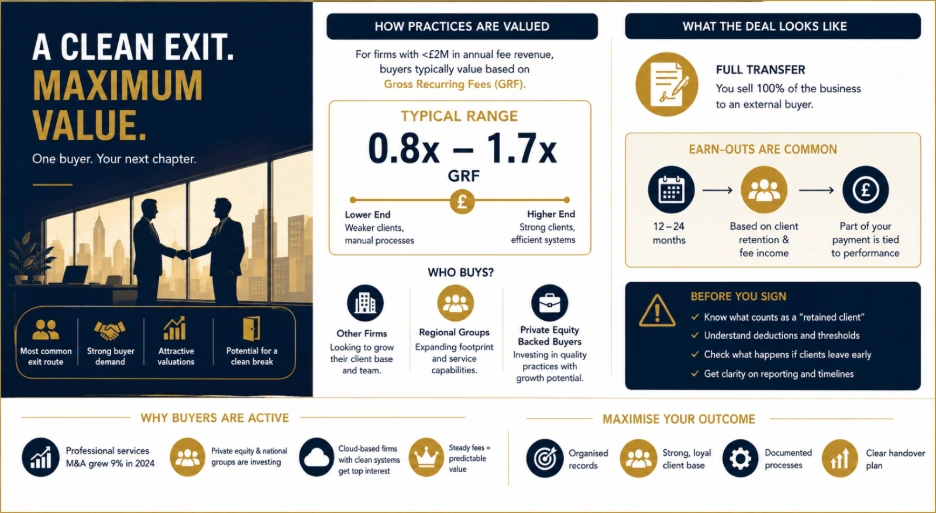
Demand is strong right now. UK professional services M&A grew by 9% in 2024. Private equity and national groups are actively buying smaller practices with steady fees. Cloud-based firms with clean systems get the most interest.
What an Outright Sale Looks Like
In the United Kingdom, most firms which earn less than £2 million in fee revenue per year are valued based on their gross recurring fees (GRF). The general range is 0.8x-1.7x GRF, and where one falls is largely a function of their clients and internal processes.
A third-party sale can mean a clean break. But deals often include earn-out clauses. These tie part of your pay to client numbers over 12 to 24 months after the sale. If clients leave early, you get paid less. Know what triggers that before you sign.
Merging Your Practice
A merger is not the same as a sale. Two firms join together, usually as equals. Neither firm just goes away. Leadership, branding, and clients all get worked out between the two sides.
Mergers suit owners who want to step back slowly. You join with a matched firm, cut your hours, and exit when the time works. Cultural fit matters a lot. A clash between teams can push clients and staff out the door on both sides.
What Makes a Merger Work
You need to match on values, client types, and how the combined firm will run. Location is key too. Most good accounting firm mergers happen between practices in the same area.
Mergers are more complex than sales. Legal and advisory costs can add up. But for owners not ready to fully exit, a merger can be a useful middle path.
Management Buyout
An MBO is when your senior team buys the practice from you. It works best when strong second-tier leadership is already in place.
The team already knows the clients. Clients are less likely to leave. Staff have a real reason to stay. The buyer already knows how the place runs.
The Catch with an MBO
Funding is the main problem. Senior managers rarely have cash to buy a practice outright. They usually need bank loans or a vendor loan from you.
A vendor loan means you get paid over time, from future profits. You carry more risk. If the firm struggles after you leave, your payments may slow. CGT applies at 14% to 24% in the 2025/26 tax year with Business Asset Disposal Relief. That lower rate rises to 18% from April 2026.
Selling to an Employee Ownership Trust
An EOT holds your practice on behalf of all employees. You sell a stake of over 50% to the trust. Employees become indirect co-owners without putting in their own money.
A rule change in November 2025 cut the CGT relief from 100% to 50%. That means around 12% effective CGT on the gain. It’s still one of the most tax-efficient exits you can make.
Is an EOT Right for You?
An EOT works best when you have a strong team and want to keep the firm’s culture intact. It’s not a fast exit. The price is paid from future profits, so you get money over a number of years.
Employees can get up to £3,600 per year in tax-free bonuses. Firms in employee ownership tend to keep staff longer and grow more steadily over time.
Internal Succession: Family or Key Staff
Transfer of the practice to a family member or associate is more common in small businesses. If done effectively, it maintains the client base and culture; otherwise, it leads to conflicts and loss of clients.
Begin the discussion at an early stage and be professional about it. Heads of terms document is not legally binding; however, it gives clear objectives to both parties. Plan the funding ahead if required by the purchaser.
Making Internal Succession Work
Develop your successor over time. Train them in client care and leadership, not just technical work. Clients need to meet the new owner well before the handover date.
Clawback clauses come up in internal deals too. If a block of clients leaves in the first year, the agreed price may drop. Read these terms closely and get your own legal advice before you sign.
Partial Sale or Block of Fees
You don’t have to sell everything at once. Many owners sell part of their client base to another firm and keep the rest.
This brings in cash without a full exit. It suits owners who want to work less but aren’t ready to stop. You keep the clients you enjoy and let the rest go.
Phased Retirement
Some owners sell the practice but stay on as a paid consultant. The buyer wants a smooth shift. You want income during the change. Both sides agree on a short-term role.
These deals usually run for six to twenty-four months. The longer the period, the more settled clients feel. For the seller, it eases the income drop that a sudden exit brings.
How Much Is Your Practice Worth?
Valuation is where most owners get a surprise. The number in your head is often higher than what buyers will pay.
In the UK, practices are most often valued on gross recurring fees. The current range is 0.8x to 1.7x GRF. A well-run, cloud-based firm with strong client retention sits at the top. A firm that leans heavily on the owner and runs on old systems sits lower.
What Buyers Actually Look At
Recurring fees matter most. Clients on monthly plans are far more appealing than seasonal tax work. Client concentration is another factor. One client making up 25% of your fees is a risk buyers will price in.
Your systems matter too. Buyers want digital records, written processes, and staff who can work without you there. A practice that can’t run without the owner takes longer to sell and sells for less.
The Tax Picture in 2025 and 2026
Business Asset Disposal Relief cuts CGT on qualifying sales. The rate was 10% up to April 2025. It rose to 14% from April 2025. It rises again to 18% from April 2026. The lifetime cap is £1 million. This hits outright sales and MBOs the most.
The CGT break on EOT sales was also cut from 100% to 50% in November 2025. At current rates that works out to around 12% effective tax. That’s still lower than most other routes.
Inheritance Tax Changes in 2026
Inheritance tax matters if you plan to pass the practice to family. Business Property Relief will be capped at £1 million per person from April 2026. Shares above that limit get only 50% relief.
This changes the numbers on family succession quite a bit. If you were planning to rely on BPR, take advice now. The change takes effect in April 2026 and waiting isn’t risk-free.
Your Succession Planning Timeline
Starting early is the only way to stay in control of the outcome.
Five or more years out: Decide what you need from the exit. Start cutting your personal reliance on the practice. Three to four years out: Develop your internal successor if that’s the path. Start tax planning. Two years out: Get a proper valuation. Engage a broker if selling externally. One year out: Tell staff and key clients. Sign heads of terms. Start due diligence.
Who Struggles with Standard Routes?
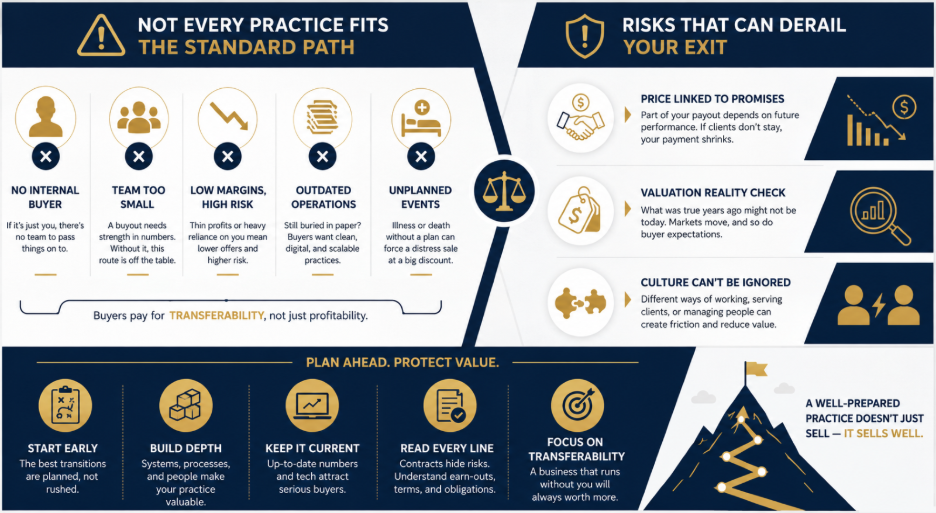
A sole practitioner with no staff has no one to sell to internally. An MBO isn’t an option if your team lacks depth. Practices with low margins or heavy owner-dependence often get lower offers.
If your practice still runs mainly on paper, buyer interest is limited. And if illness or death forces a transfer before any plan is in place, a practice with no written systems is hard to sell at full value quickly. That’s the reality most succession articles skip.
Worst-Case Scenarios
Earn-out clauses cause the most post-sale disputes. Part of your price depends on clients staying. If clients leave faster than expected, you get less. Always read these in detail.
Overvaluing the practice is also common. Markets change. A valuation from a few years ago may not match what buyers will pay today. Culture clashes in mergers are another issue. Two firms with different styles and client expectations can hurt each other even when the numbers look right.
A Quick Succession Planning Checklist
Get a realistic valuation based on current market data.
- Decide whether you want a clean exit or a phased one.
- Check whether internal succession is truly an option.
- Review your client base for concentration risk.
- Make sure all client engagement letters are current.
- Write down your key processes clearly.
- Get tax advice on your specific route.
- Use a solicitor for heads of terms and any sale agreement.
- Plan how and when you’ll communicate with staff and clients.
Thinking About Your Next Step?
If you’re starting to weigh up your options, Arbitrage Advisory works only with accountancy practice owners across the UK.
We manage practice sales, mergers, valuations, and acquisition support, with a no-sale, no-fee model and a fully confidential process.
If you’d like a clear view of what your practice is worth right now, a free initial call is a good place to start.
Here is the FAQ section with the questions lengthened by 3 to 4 words to make them more descriptive and specific, while leaving your answers completely untouched:
Frequently Asked Questions
Allow at least two years. For internal sales or complex deals, three to five years gives you far more control.
Most UK practices sell at 0.8x to 1.7x gross recurring fees. Profitability, steady fees, and how much the practice needs you all affect where you land.
A sale is cleaner and faster. A merger suits owners who want a slow step back without a full exit.
Yes. Partial sales and block-of-fees deals are common. They let you reduce your workload without giving everything up.
It depends on the route. Outright sales and MBOs attract CGT with potential BADR relief. EOTs have a 50% CGT break after November 2025.
You don't have to. But a specialist broker offers confidentiality, vetted buyers, and deal experience that most owners don't have on their own.