

Most accountancy practice owners think Business Asset Disposal Relief works the same way it did a few years ago. It doesn’t. The rate is now 18%. A lot of sellers will pay more than they planned.
That’s the real issue. Not the forms. Not the eligibility list. It’s the quiet belief that the rules haven’t changed, when they clearly have.
If you’re thinking about selling your accountancy practice, this article explains what Business Asset Disposal Relief means right now. It covers how much the 18% rate costs you. It also flags what can go wrong if you don’t plan ahead. This matters most if you’re a year or two from going to market.
Business Asset Disposal Relief, called BADR for short, is a Capital Gains Tax relief. It lets you pay a lower rate of CGT when you sell a qualifying business or business assets. Before 2020, it was called Entrepreneurs’ Relief. The name changed but the purpose stayed the same.
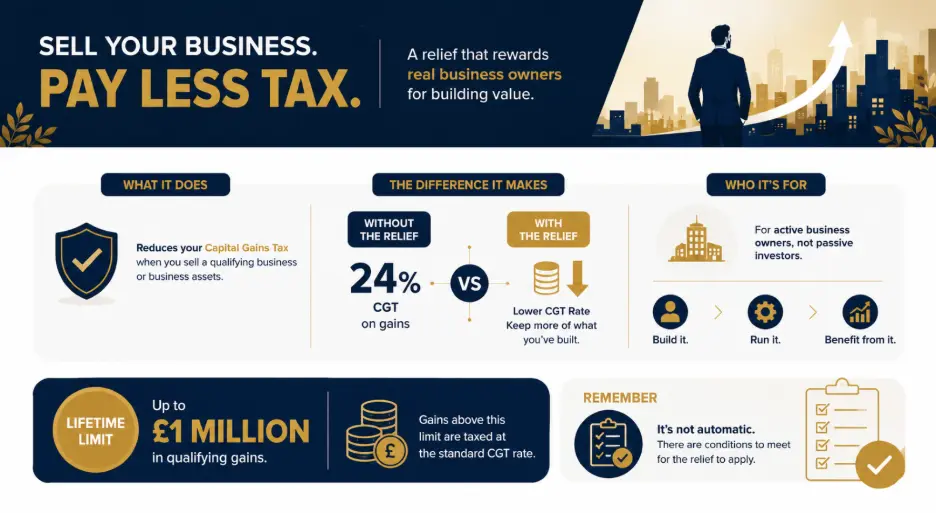
Without BADR, higher-rate taxpayers pay 24% CGT on most business gains. With BADR, you pay less. The aim is to reward people who build and run real businesses. It’s not for passive investors or short-term holders.
It’s not a blanket deal, though. There are conditions to meet. The relief is capped at a lifetime limit of one million pounds in qualifying gains. Gains above that cap are taxed at the standard CGT rate.
It helps to see BADR in the context of CGT as a whole. When you sell a business asset at a profit, you pay Capital Gains Tax on the gain. The gain is the sale price minus what you paid for it and any allowable costs.
The CGT annual exemption is three thousand pounds. That reduces your taxable gain a little. But on a practice sale, the big number usually far exceeds that. The exemption is a small help, not a solution.
BADR is what makes the real difference. It cuts the rate on qualifying gains from 24% down to 18%. For a practice worth several hundred thousand pounds, that gap matters. Know it before you start talking to buyers.
The history here matters a lot. For years, BADR sat at a flat 10%. It was generous. Many practice owners built their exit plans around it.
Then came the Autumn 2024 Budget. The rate rose to 14% from 6 April 2025. From 6 April 2026, it went up again to 18%. That’s three rate rises in under two years.
In real terms: a one million pound gain at 10% cost you one hundred thousand in CGT. At 14%, that rose to one hundred and forty thousand. At 18%, it’s now one hundred and eighty thousand. That’s eighty thousand more than the old rate, on the same deal.
The gap between BADR and the standard 24% CGT rate is closing. BADR still saves you money. But less than before, and the trend is clear.
Some people still search for capital gains entrepreneurs relief or capital gains tax entrepreneurs relief. These terms all point to BADR. The relief was renamed in 2020 but the old name still shows up.
If your accountant or a buyer mentions entrepreneurs relief, they mean BADR. The conditions, limits, and rates are the same. Don’t let the different name confuse you when reading older guides.
People often assume they’ll qualify without checking. That can be a costly error.
For shares in a trading company, you must meet four tests in the 24 months before the sale. You need to hold at least 5% of the ordinary shares and 5% of the voting rights. You need to be entitled to at least 5% of profits or net assets. You must be a director, officer, or employee. The company must be a trading company, not an investment business.
For sole traders and partners, you need to own the business for at least two years. It must have been trading at that time. The assets sold must also be genuine business assets.
Two years sounds easy. But timing matters. If you changed your ownership or employment status in the past two years, your eligibility may be at risk.
This is the one that catches most people out. BADR has a lifetime limit of one million pounds. That covers your whole life, not just one sale.
If you sold a business before and used part of your limit, you may have less left than you think. Once it’s gone, it’s gone. Any gains above get taxed at the full CGT rate.
You can claim BADR more than once, across different sales, until you hit the ceiling. Couples each have their own limits. If both you and your spouse hold qualifying shares and both meet the tests, you each get one million pounds. In the right setup, that doubles your total relief.
Say you sell your accountancy practice, and the gain is six hundred thousand pounds. Under BADR, you’d pay 18%: one hundred and eight thousand in CGT.
Without BADR, a higher-rate taxpayer pays 24%: one hundred and forty-four thousand. BADR saves you thirty-six thousand in this case.
On a full one-million-pound gain, BADR saves you sixty thousand compared to the 24% rate. That’s still real money. But it’s much less than the ninety thousand you’d have saved at the old 10% rate.
The math’s has shifted. Your net proceeds are lower than they’d have been two years ago, for the same deal, same buyer, same price. It’s worth knowing the numbers before you go to the market.
Some practice owners close their firm through a Members’ Voluntary Liquidation, or MVL, rather than a sale. BADR can apply here too. That’s why liquidation often comes up in BADR discussions.
In an MVL, the company is a solvent. Assets go to shareholders. Those payments are often treated as capital, not income. If you meet the BADR tests, the 18% rate can apply to qualifying gains on those payments.
This route suits owners who want a clean close rather than a full sale process. But the conditions still apply. The company must have been a trading company for the full two-year period. Getting this wrong is very costly.
Here’s something that has caught people off guard. Signing a contract before 6 April 2026 doesn’t lock in the old 14% rate on its own. Many sellers assumed it would.
The government added anti-forestalling rules. A contract must have been unconditional before 6 April 2026 to count as an excluded contract. If it still had open conditions, such as signoffs, earn-out terms, or warranty talks, it likely won’t qualify.
There’s also a rule that the contract must not have been signed mainly to gain from the timing. If the two parties are connected, the deal must be purely commercial.
A signed contract doesn’t always mean protection. If your deal still had open terms at the April 2026 cut-off, get advice before assuming a lower rate applies. The numbers are big enough to check carefully.
Not everyone can use BADR. It helps to know where relief doesn’t apply.
If you’ve used your full one-million-pound lifetime limit on past sales, there’s no further BADR benefit. Extra gains go to the 24% standard rate.
Non-UK residents face different rules. BADR is a UK relief. Your tax status depends on your residency. Don’t assume it applies without taking advice first.
If you hold fewer than 5% of the shares, you can’t claim on a company sale. BADR is aimed at people who work in the business. Passive holders don’t get it.
If you changed your share structure in the last 24 months, the two-year test may have reset. This includes changes made during a funding round. It can happen without you realizing the impact on your BADR clock.
These are real problems, not invented ones.
The most common issue is finding the lifetime allowance is already partly or fully used. Sellers who exited a past business often forget how much BADR they claimed at the time. Check your old tax returns before you plan your exit.
Earnouts cause problems regularly. If a deferred payment looks like employment income rather than a capital receipt, HMRC taxes it under PAYE. BADR won’t apply to that part. Sort the earn-out structure with your accountant before heads of terms are signed.
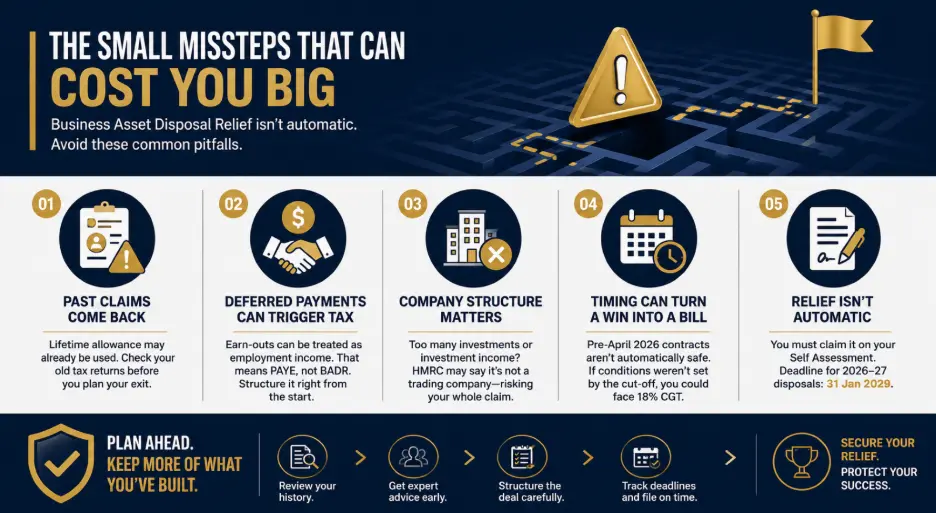
Company type errors are a trap too. If your practice holds a lot of investment assets or has had big investment income over the two-year period, HMRC may say it isn’t a trading company. That can wipe out your whole BADR claim.
Timing errors happen as well. Sellers think their pre-April 2026 contract is safe under excluded contract rules, but conditions were still open at the cut-off. The result is an 18% bill they didn’t see coming.
And some people don’t complain at all. BADR isn’t automatic. You claim it through your Self-Assessment return. For a 2026 to 2027 disposal, the deadline is 31 January 2029. Miss it and you lose relief.
The 18% rate change makes it worth getting proper advice before you go to the market. Getting your BADR status, your remaining lifetime allowance, and your deal structure right early can make a real difference to what you keep.
Arbitrage Advisory works with accountancy practice owners who are selling, merging, or exploring their options. They handle valuation, buyer introductions, and the full sale process in confidence, with a real focus on the accountancy sector.
From 6 April 2026, the rate is 18%. It was 14% from April 2025 to April 2026. Before that, the rate was 10%.
The limit is one million pounds in qualifying gains per person. Once used up, further gains are taxed at standard CGT rates.
Yes, but only on what's left. If you used five hundred thousand in a past sale, you could still claim up to another five hundred thousand.
It can. BADR applies to capital distributions through an MVL if the company qualifies as a trading company, and you meet the tests.
The first million qualifies for the 18% BADR rate, if you have the full limit left. Gains above that are taxed at 18% or 24%, depending on your income level.
Yes. The name changed in April 2020. The rates have since gone up sharply, but it's the same relief.
If both partners hold qualifying shares and each meets the conditions independently, yes. Each person has their own one-million pound limit.
You must claim BADR by 31 January 2029, through your Self-Assessment return for the 2026 to 2027 tax year.