

TUPE accountancy practice sale deals raise one big question. What happens to the team?
Here is what TUPE UK law does, in plain terms. It protects staff when a business changes hands.
Asset and business sales often trigger it. A share sale usually does not. That is because the employer stays the same.
Partial sales and block-of-fees deals sit in a grey area. Staff can bring rights and duties with them. So, check this before you complete the deal, a step that sits alongside the wider checks covered in our guide to acquiring a UK accountancy practice.
Does TUPE Apply When an Accountancy Practice Is Sold?
The deal structure decides everything. The same sale can trigger TUPE one way and avoid it another.
Asset sales: TUPE applies to asset sales where clients, staff, systems, and goodwill transfer as a single unit. The test asks a simple question. Does the business keep its identity under the new owner? A client list on its own is less likely to count. A working office with its team still in place is more likely to, which is one reason a proper practice valuation looks at more than just client numbers.
Share sales: TUPE applies to share sale questions and has an easy answer. Ownership changes, but the firm stays the same. So, contracts do not move at all. Problems can still pop up later, though. This can happen if staff get moved between group firms after the deal.
Partial sales: Selling one office or one team raises the same question, just on a smaller scale. Does that part run as its own unit? And which staff belong to it?
Block of fees: A fee sale does not always dodge TUPE. It does not always trigger it either. What counts is simple. Do the staff and systems behind those clients move too?

Which Employees Actually Transfer Under TUPE?
Only staff tied to the transferring part of the business move.
So, what does tied mean here? An employee is tied to it if they work mainly for that part. This is true even without a written label saying so.
Mixed roles are common in practices. Think of an accountant with clients on both sides of a deal. Or a shared admin who helps both teams. In these cases, time spent and client value usually decide the answer, not the job title.
Can the buyer pick and choose staff? No, not where TUPE applies. A buyer cannot take the fee income and leave the people who do the work. What happens to staff TUPE protects is simple. Staff who qualify transfer on their own, whether either side wants that or not.
What Happens to Staff When TUPE Applies?
TUPE practice: a sale-staff transfer means the job continues without a break.
Time already worked still counts. Pay, holiday and sick pay stay the same on day one.
Bonuses and benefits in the contract move too, in most cases. Discretionary schemes are the exception, so check these one by one. Old contracts stay in force on their current terms. No one needs to sign a new one just because of the sale.
What Employment Liabilities Can the Buyer Inherit?
Along with staff, a buyer can pick up several other things. This can include unpaid holiday, live complaints, threatened claims, big redundancy terms, family leave costs, and old terms from past TUPE deals.
These costs matter more than most buyers think. They shape price negotiations, contract promises, and who pays for what, and overlooking them is one of the more common practice sale value mistakes we see. A practice that looks cheap on fees can hide costly staff issues underneath.
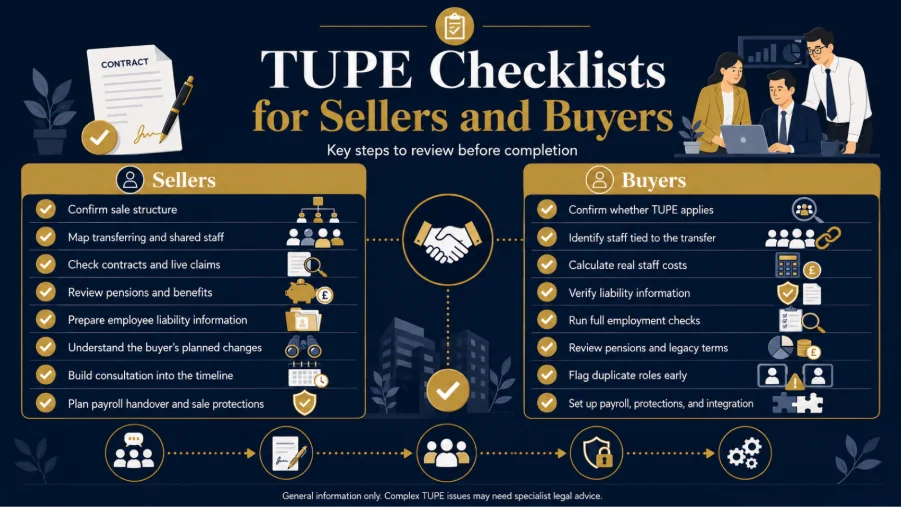
TUPE Due Diligence Checklist for Practice Buyers
Run a TUPE due diligence checklist before you sign anything. Check these areas:
- Contracts and start dates
- Pay and benefits
- Absence and family leave records
- Open complaints or claims
- Pension setup
- Past TUPE deals
- Right to work checks.
Do this before completion. It protects the price you agreed.
What Is Employee Liability Information?
TUPE employee liability information is the least a seller must hand over by law. It covers names, ages, terms, pay, and any complaint or claim history from the last two years.
Acas sets a clear deadline here. This must land at least 28 days before the transfer date. It must be updated fast if anything changes.
Keep this in mind, though. It is not the same as a full check of the business. It is a floor, not the full picture. So, look into the culture, the workload, and the unwritten rules too.
What Is the TUPE Process Step by Step?
Follow this TUPE process step-by-step:
- Confirm the deal structure.
- Check if TUPE applies.
- Find the transferring staff.
- Run your checks
- Set out the buyer’s planned changes.
- Swap employee liability information.
- Tell staff and consult them.
- Set up payroll and HR.
- Complete the deal
- Handle the settling-in period.
When Should Staff Be Told About the Practice Sale?
Staying private and talking to staff pull in two directions at once. That tension is real.
Keep deal terms quiet for as long as you reasonably can. But plan your talks with staff early too, so they do not get rushed at the end.
Here is the key point, though. You cannot wait until completion to tell staff. Talks must happen before the deal closes, with real time for staff to respond.
How Long Does TUPE Consultation Take?
There is no set TUPE consultation period length in law. Instead, it must run long enough to mean something, given what is on the table.
Start talks as soon as your plans firm up. Unions or elected staff reps must be included where they exist.
What if a practice has none, and is small? Then you can talk to staff one-on-one in line with the TUPE consultation requirements under UK rules.
What Are Measures Under TUPE?
Measures are changes the buyer plans to make after the deal. Think new pay dates, a new office, or a reshuffle.
The buyer must tell the seller about these plans early. That way, staff get consulted properly before the deal closes.
Can the Buyer Change Employment Contracts After TUPE?
Not just because of the transfer, no. Any change where the transfer is the main reason is void by law. This holds even if the staff member agrees, unless a real ETO reason applies.
Handing everyone a shiny new standard contract is not automatic either.
This is where the TUPE harmonizing-terms mistake most often shows up. Say your team gets 25 days’ holiday, and new staff arrives with 28 days. Cutting them down to 25 for a tidy system, with the sale as the true reason, is exactly what the law blocks.
How Long Does TUPE Protection Last?
There is no six-month, one-year, or two-year cutoff. That myth will not die.
Protection runs on, with no end date. What matters each time is the real reason for a change and how closely it relates to the sale.
Can Staff Be Made Redundant After TUPE?
Yes, TUPE does not stop redundancy outright.
An ETO reason, short for economic, technical, or organizational, covers a real business need. A good example is two payroll teams that now do the same job, the kind of overlap that often surfaces once our mergers advisory team is helping map out how two practices will combine.
Planning can start early. But sacking staff just so the buyer skips taking them on is illegal. And there is no hidden one- or two-year ban in the TUPE redundancy rules in the UK either.
TUPE vs Redundancy: What Is the Difference?
| TUPE | Redundancy | |
| Purpose | Protects jobs through a transfer | Ends a job when it is not needed |
| Employment | Goes on with the new employer | Ends with a payout |
| Trigger | A business or service changes hands | A role is no longer needed |
TUPE vs redundancy UK cases matter for one big reason. The two often overlap around the same completion date.
What Happens to Pensions and Payroll After TUPE?
TUPE pension rights transfer rules leave out most work pension perks tied to old age, illness, or death in service. Even so, the buyer must still offer a basic pension to eligible staff.
A similar scheme is usually fine as a swap. Still, check this with a specialist. Do not assume.
The TUPE payroll pension transfer process requires a few things to be ready on day one. This means service dates, correct pay, tax records, holiday balances, and pension deductions all lined up.
Can an Employee Refuse to Transfer?
Yes, they can say no. This usually ends their job, with no redundancy pay, since they chose not to move. But there is a catch. If the new role would be much worse, the case gets more complex and may support a claim.
What Happens If TUPE Is Handled Incorrectly?
A TUPE failure-to-consult penalty can amount to up to 13 weeks’ pay per affected staff member. This is separate from the collective redundancy award.
That award doubled to a maximum of 180 days’ pay per staff member. This came under the Employment Rights Act 2025, from 6 April 2026. It covers large-scale redundancy failures in general, not TUPE talks alone.
There is more risk beyond that too. If the liability information is incorrect or submitted late, the buyer can claim a refund. This starts at around £500 per staff member.
Any sacking where the transfer is the main reason brings TUPE unfair dismissal risk. Poor handling causes real harm elsewhere too. Think delays, disputes over promises made, and messy client handovers.
How Should TUPE Be Addressed in the Sale Agreement?
The deal papers should cover a few key things. This means staff promises, TUPE cover clauses, a list of known issues, a clear split of who pays for what, and the changes the buyer plans to make, all of which should be worked through as part of a wider practice sale plan.
Leave the actual drafting to a qualified lawyer, though. This is not a part to handle on your own.
Common TUPE Mistakes When Buying or Selling a Practice
Here are the common TUPE mistakes UK buyers and sellers make most:
- Thinking TUPE applies to every sale
- Treating asset and share sales the same way
- Thinking a fee sale always dodges TUPE.
- Thinking every staff member transfers
- Missing staff shared across teams.
- Treating ELI as the full check
- Telling staff too late
- Assuming talks must run exactly 30 days
- Mixing up TUPE talks with redundancy talks
- Making terms match too soon
- Believing TUPE ends after two years
- Planning cuts with no TUPE check first.
- Ignoring pensions
- Leaving payroll unready
- Not splitting who pays for what in the sale papers.
What Are the TUPE Rules in 2026?
The core rules have not changed much. Day-to-day TUPE rules for practice sales remain unchanged.
That said, change is being talked about. The government opened a call for views on TUPE reform 2026 UK in April 2026. It closed on 1 July 2026 and asked how well TUPE works in real life.
No firm changes have been put forward yet. And any next round of talks has no set date so far.
Under the wider employment rights act TUPE changes push, the collective redundancy award doubled from 6 April 2026. That affects large redundancy cases in general, not TUPE talks. Treat it as useful background, not a TUPE rule change.
When Should You Get Specialist TUPE Advice?
Bring in a TUPE solicitor or practice sale expert for these cases: part sales, block of fees deals, arguments over who counts as staff, shared staff, planned cuts, tricky pensions, past TUPE deals, live claims, or planned contract changes.
So, what about cost? The cost of TUPE legal advice depends on the size of the deal, the number of staff, and how tricky it gets. It also depends on whether it covers TUPE alone or the whole deal, much like the way funding costs are scoped out in our acquisition finance guide. Ask for a set quote once the structure is clear.
Plan the Staff Transfer Before You Complete the Practice Sale
Where you go next depends on your deal.
If it is a straight share purchase, first check whether the employer is changing. If it is an asset purchase, check TUPE before you commit to anything. If part of the practice, or a block of fees, is moving, work out what is really being sold, and which staff go with it.
Planning cuts or contract changes? Get advice before you act, not after. Buying a practice? Finish your staff checks before you take on its costs, using the same criteria set out in our guide to acquiring a UK accountancy practice. Selling one? Get staff information ready early and build talks into your timeline from day one, a step worth planning alongside your broader succession plan.
Keeping staff on board is not a small matter here. Clients tend to follow the people who look after them. So, getting the staff moves right protects the value you are trying to sell or buy.
That links straight back to price, buyer trust, and how smoothly the deal closes.
If you are buying or selling an accountancy practice, staff issues should sit alongside price, checks and deal structure. Arbitrage Advisory can help you plan the wider deal, spot risks early, and move toward completion with a clearer plan. Speak to our team about your practice sale or purchase.
This article gives general information on TUPE. It is not legal advice. Talk to a qualified employment lawyer about complex TUPE or staff law questions.
Often, yes. A merger usually means one business absorbs another. If staff, clients, and work move as a single unit, TUPE is likely to apply, even if both sides may call it a merger rather than a sale.
What if the buyer already has someone doing the same job as a transferring employee?
Both staff members keep their jobs at first. TUPE does not let the buyer drop one just because the roles overlap. A later redundancy is lawful only with a genuine ETO reason and handled through the proper process.
Yes, size does not switch TUPE off. Even a one-person or two-person practice can trigger TUPE on a sale. The main change for small practices is simpler consultation, not an exemption from the rules.
Can consultation happen after contracts are signed but before completion?
Yes, this is common. Many deals are signed first and completed later, once conditions are met. Consultation should take place during that gap, giving staff proper notice well before the transfer.