

Completion day feels like the finish line. It isn’t.
The real test starts the next morning. Clients want to know who’s looking after them now. Deadlines don’t wait. They carry on, no matter who owns the firm.
The first 100 days accounting practice period is what decides the outcome. It decides whether the goodwill and fees you paid for stick around, and this is precisely why choosing the right target matters so much before you ever get here, as we cover in our guide to acquiring the right UK accountancy practice. This guide walks you through what to protect, what to fix, and what to leave alone.
What Should You Do in the First 100 Days After Buying an Accountancy Practice?
First, protect what you bought. Improve it later.
That means client relationships. Key staff. Deadlines. HMRC authority. AML checks. Engagement letters. System access. Integration costs.
A missed deadline breaks trust fast. A confused client might just call the old firm instead of you. So, think of the first 100 days as risk control first. Growth comes second.
The First 100 Days Accounting Practice Integration Timeline
A clear accounting practice integration timeline stops key tasks from slipping through the cracks.
Before Day 1: Agree the seller’s plans for handover. Find out who holds the keys to every system. Note the key staff, the riskiest clients, and any deadlines that fall due soon.
Days 1–7: Take charge of systems, bank mandates, and records. Write up a short list of risks. Check every deadline due in the next 30 days. The rule here is simple: get stable first. Improve later.
Days 8–30: Most of the client and staff work happens now. At the same time, start on HMRC authority, AML checks, and engagement letters.
Days 31–60: Line up your workflows and who does what. Check if your current software can cope with more clients.
Days 61–90: Look for duplicate systems and low-margin clients. Check if your staff numbers match the new workload.
Days 91–100: Add it all up. How many clients and how much revenue did you keep? How many staff stayed? Did deadlines hold? Are you on budget? This is your new baseline.
How Do You Protect Client Retention After a Practice Acquisition?
Client retention after practice acquisition is what protects the money you just spent. Lose clients, and the deal stops making sense.
Start by sorting your clients into groups. Look at fees, profit, how close they were to the old owner, and any complaints on file. Some clients need a personal call from the seller. Others are fine with a joint meeting. Some just need a good email. Don’t assume trust carries over just because the contract does.
Most clients are quietly worried about the same few things. Will their accountant change? Will fees go up? Are their deadlines still safe? Answer these questions early, before clients have to ask.
Keep an eye out for warning signs too. Complaints. Clients going quiet. Clients who still ring the old firm instead of you.
How Should the Seller Handover Be Managed?
Set a clear transition period, with clear hours. Don’t settle for a vague “I’ll help if you need me,” and it’s worth checking what buyers are told to expect from a seller during this stage in our guide to what buyers should know before registering interest.
The seller should join client introductions, answer technical questions, and support any staff who leaned on them. Build a simple knowledge log too. Note client habits, special pricing deals, and any workarounds no one wrote down.
This fixes the most common complaint after a deal closes: the seller knew everything, but none of it was on paper.

Does TUPE Apply When Buying an Accountancy Practice?
Whether tupe accountancy practice acquisition rules apply comes down to how the deal was built, a distinction we set out fully in our guide to what TUPE means for staff during a practice sale.
Buy the assets, and staff usually transfer over on their old terms. Buy the shares instead, and TUPE usually doesn’t apply, since the company itself hasn’t changed hands.
But it’s not always that clean. Tribunals have found TUPE can still apply after a share deal, in some restructuring cases. Get employment law advice that fits your exact deal. Don’t just assume either way.
How Should HMRC Agent Authorisations Be Managed After Acquisition?
Buying a practice doesn’t hand you the seller’s HMRC authority. Each client’s authority needs a fresh look. In most cases, you’ll need to set it up again under your own details.
The right method depends on the service. Notify HMRC change of accountant rules aren’t the same for every service. Some use a digital handshake, done by the client through their own HMRC account. Self-Assessment usually runs through Online Agent Authorisation. Some cases still need a paper 64-8 form change of agent.
HMRC has also brought in mandatory two-step login checks for agent accounts, rolling out through 2026. Check your own setup covers this too. Go through your client list service by service. Don’t assume one method fits everyone.
Do AML Checks Need to Be Repeated for Acquired Clients?
Not always, but you can’t just take the seller’s word for it.
AML checks acquired practice clients’ rules mean you must check the old due diligence yourself. Make sure it meets your own rules, not just the seller’s. Check identity, business ownership, risk rating, and sanctions screening.
Use a simple process: review it, check it holds up, spot the gaps, fix them where needed, and note your decision.
Do Acquired Clients Need New Engagement Letters?
In most cases, yes. Engagement letters after practice acquisition protect both sides. They set out the services, who’s responsible for what, fees, liability, and how client data gets handled under the new firm.
An old letter from the seller leaves too many gaps. Start with your highest-risk and highest-value clients first.
What Regulatory and Insurance Issues Need Attention?
Does your firm hold ICAEW registrations, such as audit, probate, or DPB investment business? If so, you’ll usually need to tell ICAEW about ownership changes within a set number of days. This keeps your registrations valid and your AML supervision in place. The exact rules depend on your professional body, so check what applies to you.
Tell your insurer promptly too, since your risk profile has just changed. Think about old claims risk, whether you need run-off cover, and how the deal structure affects who’s liable for what.
How Do You Protect Client Deadlines During Integration?
Run a 30-day deadline sweep on every client you’ve taken on. Note the service, the next deadline, the work status, who’s responsible, and how risky it is.
Cover accounts, Corporation Tax, VAT, payroll, Self-Assessment, and Confirmation Statements. Clients don’t care that the firm changed hands. Missing a deadline is one of the fastest ways to lose their trust.
Can the Existing Team Service the Acquired Client Book?
This gets missed more often than it should. Look honestly at client numbers, the fees you’ve taken on, your headcount, and how busy staff already are. Is there one person your firm can’t run without?
You might need to hire, bring in temp staff, outsource work, or redesign a workflow. Extra clients without the staff to serve them well often just turn into lost clients, not extra profit.
Should You Change the Practice Management Software Immediately?
Not necessarily. Rushing a system change during an already shaky period only adds more risk.
Check your current tech setup first. Then test if you’re ready to migrate look at deadlines, data quality, how systems connect, and staff readiness. A good order for practice management software migration is: settle in, map it out, clean the data, test it, train the team, migrate, then check it worked.
What Should You Avoid Changing Too Quickly?
Hold off on changing pricing, account managers, software, client portals, staff roles, billing cycles, and branding, all at once. Each one touches something a client or staff member relies on.
That said, real risks to compliance, security, or service still need action now. The real question isn’t whether to change things. It’s how much change the practice can take without you losing what you paid for.
How Should Underpriced or Low-Margin Clients Be Handled?
Look at what it truly costs to serve each client. Check actual profit, past write-offs, and how much work each one takes. Raising every fee on Day 1 is a fast way to lose clients, right when you can least afford it, the same underpricing risk we flag among the mistakes that kill accountancy practice sale value from the seller’s side of the deal.
A proper fee review, done once things have settled, protects both your clients and your margin.
What Are the Hidden Costs of Integrating an Accounting Practice?
The cost of integrating an accounting practice is never just the price you paid.
Common hidden costs buying an accounting practice include working capital, fees for the seller’s help, cover for new hires, and training. Add duplicate software, AML clean-up work, insurance changes, lost productivity, write-offs on unfinished jobs, and clients who leave, all worth budgeting for alongside however you’re funding the acquisition itself.
The true cost always runs higher than the headline price. Budget for that before you complete the deal.
Common Integration Mistakes and Warning Signs
Avoid these common mistakes when integrating a newly acquired accounting practice:
- Changing too much, too quickly
- Underestimating how heavily the practice depends on the seller
- Overlooking key staff and the client relationships or knowledge they hold
- Assuming HMRC agent authorisations transfer automatically
- Failing to review inherited AML checks properly
- Migrating to new technology before the practice is stable
These warning signs typically reveal one of three underlying problems:
- Service disruption: clients experience delays, inconsistent support, or missed commitments.
- Communication gaps: clients or staff remain unclear about responsibilities, contacts, or next steps.
- Capacity constraints: the team lacks the time, skills, or resources to manage the acquired workload.
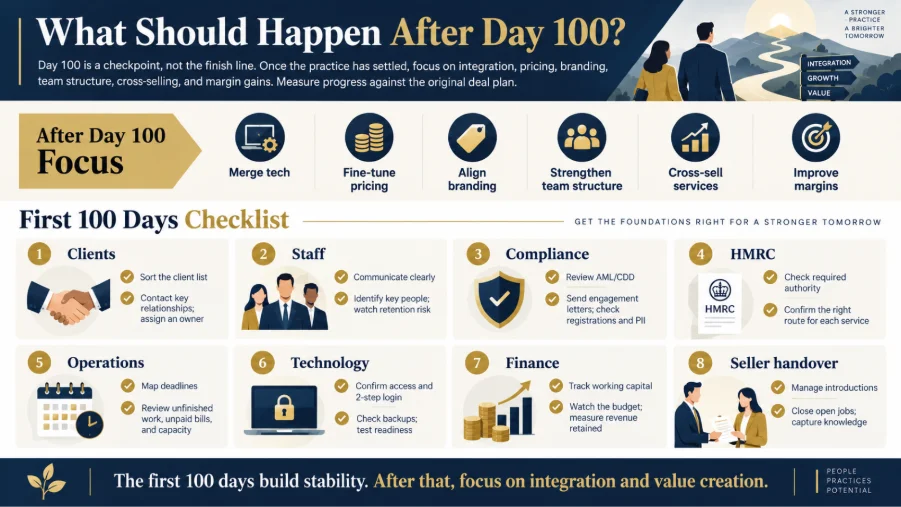
How Do You Measure Whether the Integration Has Worked?
Build a simple scorecard for Day 100. Track client numbers: retention, fees kept, and complaints. Track staff numbers: retention and workload. Track operations: missed deadlines, unfinished work, unpaid bills.
Add compliance: HMRC authority, AML checks, and engagement letters. Add money: profit margin and spend against your budget.
Conclusion
Buying the practice was the easy part. Keeping what you bought is the real work. And it happens in the exact period most buyers rush through.
Protect client relationships and deadlines first. Stabilise your team and systems next. Standardise how things run once the dust settles. Only then should you push for growth and margin.
Some calls need expert help. Whether TUPE applies, how ICAEW rules affect you, and how your PII cover should respond all need proper legal, tax, or insurance advice, not general tips. Get that input early.
By Day 100, you should know exactly where you stand. Which clients stayed? Which staff did you keep? Did deadlines hold, and is spend on track? That tells you if the deal is working, not just whether it closed.
If you’re planning to buy a practice, or you’ve already exchanged and want the first 100 days to go well, start your integration plan before you complete, not after. Arbitrage Advisory helps accountancy practice buyers with deal structure, getting buyer and seller aligned, and planning the transition through our acquisition support service. That means the risks get caught early, so the clients, staff, and fees you’re paying for stand a real chance of still being there in 100 days’ time.
FAQs
Lock down system access and client records. Confirm what each staff member is responsible for. Run a 30-day deadline check right away.
Most firms treat 100 days as the core settling-in period. But 90-day integration plan that accountancy buyers often follow can stretch into full integration over several months.
In most cases, yes. New letters spell out services, fees, and who’s responsible for what under the new firm.
Not always. But you must check the old due diligence and confirm it meets your own rules.
No. Each client’s authority usually needs setting up again. The right method depends on the tax service in question.